Dyno · November 20, 2026 · Lucky Strike Cycles, Tempe
Yes. If you put a new exhaust or a high-flow air cleaner on a fuel-injected Harley or Indian, it needs a tune. Those parts change how much air the engine moves, and the factory computer is still fueling for the stock parts, so the bike runs lean. A tune rewrites the fuel and timing to match what's actually on the bike.
That's the short answer we give at the counter about once a day. Riders from Mesa and Gilbert ride in with fresh pipes, a great sound and a bike that suddenly pops, surges or runs hot. Here's why it happens and what to do about it.
Why does a new exhaust or air cleaner make a bike run lean?
A new exhaust or air cleaner lets the engine move more air, and the factory fuel map doesn't add fuel to match. Your engine is an air pump. Stock intake and exhaust parts are built to keep the bike quiet and clean enough to pass emissions rules, and they restrict airflow to do it. Swap them for freer-flowing parts and more air goes through.
The computer decides how much fuel to add by reading tables that were written for the stock parts. It can make small corrections using its oxygen sensors at light, steady throttle, but only within a narrow window. Roll on harder, like merging onto the 60 or passing on the Beeline, and the bike is running off those stock tables. More air with the same fuel means a lean mixture, and a lean V-twin runs hot and doesn't pull the way it should.
So the new parts are only half the job. The tune is the other half.
Slip-ons, full systems and air cleaners: what needs a tune?
- Slip-on mufflers. The smallest change. Some mild slip-ons on an otherwise stock bike will run on the factory map without obvious trouble, but they're still leaner than they should be. Louder, freer slip-ons almost always show it. If you're adding slip-ons now and an air cleaner later, plan the tune for when both are on.
- High-flow air cleaner. A real change in airflow on its own. Plan on a tune.
- Full exhaust system (2-into-1 or true duals). A big change in how the engine breathes, and it often moves where the bike makes its torque. Needs a tune, no question.
- Air cleaner plus exhaust. This is the classic Stage 1 setup, and it needs a tune. Bolting it on without one is how riders end up with a louder bike that feels flatter than stock.
- Cams, big bore or stage kits. Tuning isn't a maybe here. Brands like Feuling and S&S Cycle build great parts, but they're designed to be tuned. More on that in our performance upgrades.
Signs your bike is running lean after new parts
You don't need a gas analyzer to notice a lean bike. These are the things riders describe when they come in:
- Popping and crackling on decel. Some riders like it. It usually means the mixture is off, and it isn't doing your exhaust any favors.
- Surging at steady low speed. The bike lurches and bucks at a constant 25 or 30 through a neighborhood, which gets old fast on Gilbert Road.
- Stumble or hesitation when you roll on. Especially in top gear at lower RPM.
- More heat on your legs. A lean engine runs hotter. In a Valley summer, sitting at a long light near Mesa Riverview with a lean motor is no fun.
- A check engine light. Sometimes the computer notices before you do.
- It's louder but not faster. If the new pipes sound like more power and the bike feels like less, it probably is less.
None of these are an emergency, but don't ride around for months on a lean setup. Heat is hard on an air-cooled V-twin, and it adds up.
Can I just download a map instead of a dyno tune?
You can, and a pre-built map is better than nothing. Tuners like Power Vision by Dynojet come with maps for common exhaust and air cleaner combinations, and they'll get a bike closer than the factory tables. The catch is that a downloaded map is a good guess built on somebody else's bike. Different mufflers, different baffles, different elevation and a different engine all change what your bike actually needs.
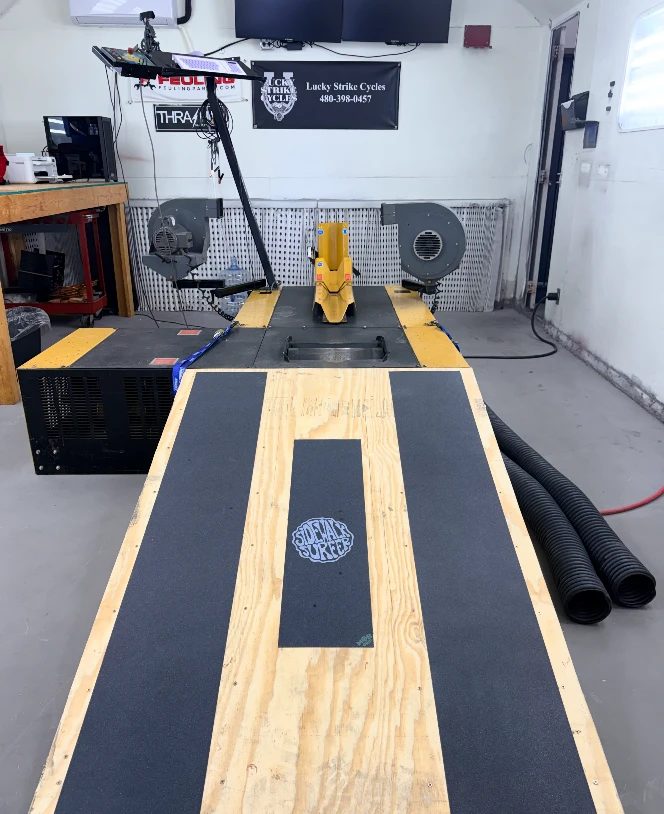
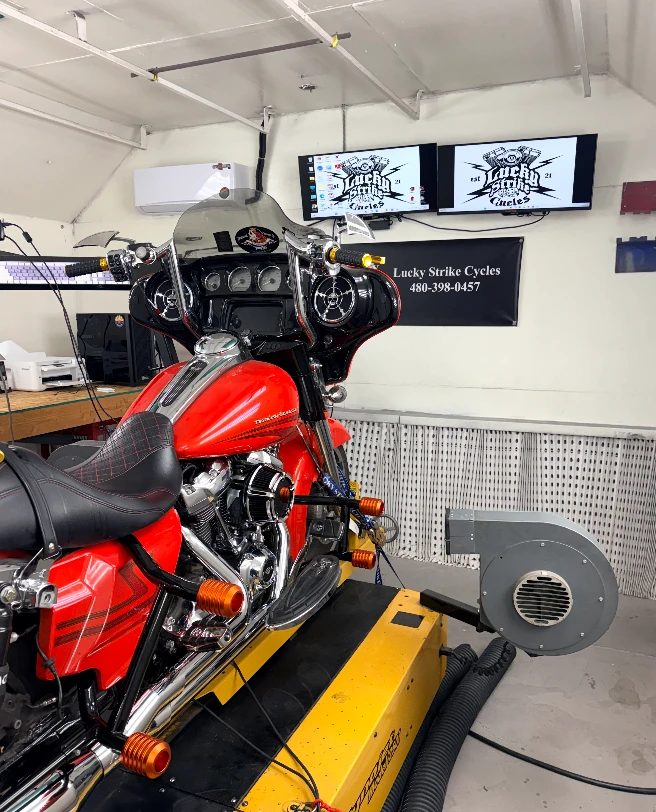
On the dyno we run your bike under real load, read what the engine is doing and correct the fuel and timing until it's right, then check it again. We tune with Power Vision by Dynojet and Mastertune by TTS in our own air-conditioned dyno room in Tempe, with cooling fans on the engine so the readings stay steady. When the tune is done, you get your horsepower and torque numbers. If you want the longer version of what happens on the rollers, read what a dyno tune actually does for a Milwaukee-Eight.
Plan the parts and the tune together
The cheapest tune is the one you only do once. If you know you want an exhaust now and an air cleaner in the spring, tell us. We'd rather help you pick parts that work together and tune it all at once than tune it twice.
A few things that make the visit go smoother:
- Buy the parts through us. We don't install customer-supplied parts. Parts from our suppliers are covered, they're the right fit for your bike, and we know exactly what we're tuning for. Our shop policy lays it out, and our parts page shows the brands we carry, including Bassani, Thunderheader, S&S Cycle and Arlen Ness.
- Tell us about any past tune. If a previous owner put a tuner on the bike, we need to know.
- Make sure the bike is healthy. A tune can't fix an exhaust leak, a bad sensor or worn plugs. Every bike gets a safety inspection when it comes in, and if we find something, we call you before we touch it.
Riding in from Gilbert, Mesa, Chandler or Queen Creek is easy: we're just north of University Drive between McClintock and the Loop 101.
Get your new parts tuned right
If you've got new pipes or an air cleaner on the bike, or you're about to, call Striker at (480) 398-0457 and tell us what you ride and what's on it. You can also start a service ticket online. We're at 1971 E 5th St, Suite 114 in Tempe, open Monday through Friday 8 to 5 and Saturday 8 to noon.