Dyno · November 17, 2026 · Lucky Strike Cycles, Tempe
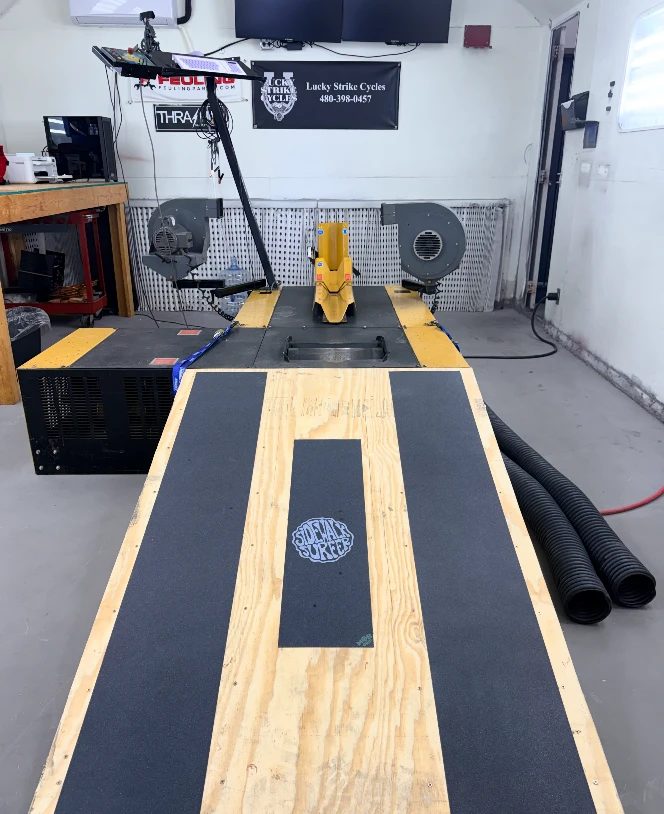
A dyno tune on a Milwaukee-Eight rewrites the fuel and ignition timing tables in your bike's computer to match the parts actually on it, and sets them while the bike is running under real load on a dyno instead of guessing. The result is an engine that pulls cleaner, throttles smoother and usually runs cooler than the lean factory map. If you've changed the exhaust, air cleaner, cams or a stage kit, a tune isn't optional: it's what makes those parts work.
We tune bikes in our own dyno room in Tempe, and the same questions come up at the counter every time. Here are the straight answers.
What does a dyno tune do on a Milwaukee-Eight?
It changes how much fuel the engine gets and when the spark fires, at every combination of RPM and throttle the bike will see. Your Milwaukee-Eight's computer runs off tables of numbers. From the factory, those tables are written to pass emissions and noise rules on a stock bike, which means they lean toward running thin on fuel, especially at light throttle and cruising speeds. That's where you spend most of your time riding.
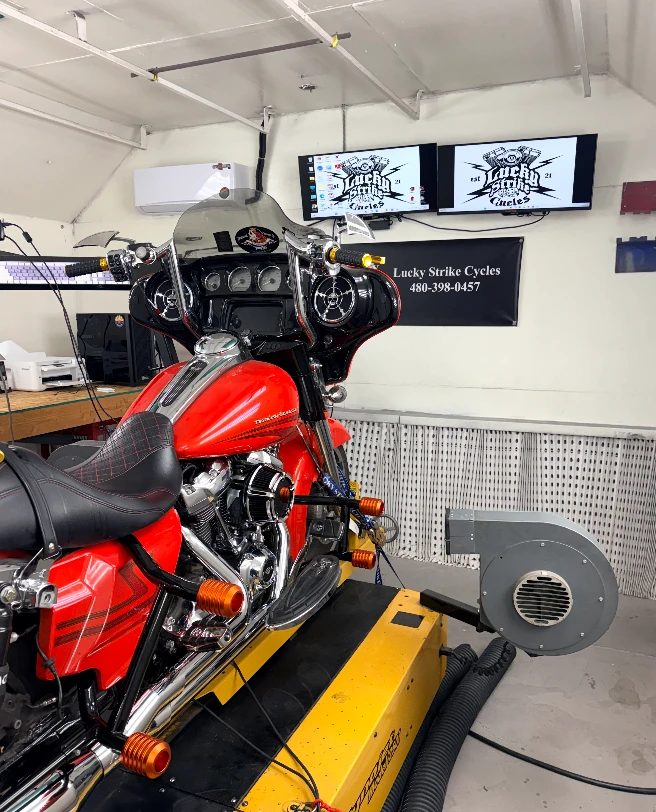
On the dyno, the bike is strapped down and run through real load, the same way it works climbing the Beeline or pulling two-up onto the Loop 101. We read what the engine is doing with sensors in the exhaust and adjust the tables so the air and fuel are where they should be. Then we check it again. A tune is a lot of small corrections, not one big switch.
What you notice on the road:
- Smoother throttle. Less of the surge and stumble at low speed that makes parking lots and stop-and-go traffic annoying.
- Cleaner pull. The engine stops hesitating when you roll on in top gear.
- Less heat off a lean motor. A V-twin that's starved for fuel runs hot. That matters a lot in a Tempe summer, and a lot of riders feel the difference on their legs before they ever see a number.
- The power you paid for. New parts without a tune often make less than they should, sometimes less than stock.
Power Vision vs Mastertune: what's the difference?
Both are tuning systems that let us read and rewrite your bike's computer. We tune with Power Vision by Dynojet and Mastertune by TTS, and the right one depends on your bike, your parts and how you ride.
- Power Vision by Dynojet is a device that plugs into the bike's diagnostic port and stays with you. It holds the tune, reads live engine data and codes, and works as a gauge display. Riders like that they can see what the engine is doing and keep the tune file with the bike.
- Mastertune by TTS is software that runs on our end and is known for detailed control over the fuel and timing tables. It's a strong choice for bikes with bigger changes, like a cam or a bigger engine package.
Honestly, the tool matters less than the person using it and the time spent on the dyno. A canned map downloaded off the internet is someone else's guess about someone else's bike. Your engine, your exhaust and your air cleaner are specific, and the tune should be too. When you come in, we'll tell you which system we'd use for your setup and why.
Do I need a dyno tune if my bike is stock?
You don't need one, but a lot of stock Milwaukee-Eights benefit from it. The factory map is built around rules, not around how the bike feels or how hot it runs in the desert. Riders who only ride stock and add a tune often notice smoother low-speed manners and less heat. If your stock bike runs fine and you're happy, keep riding it. If it pops on decel, surges at low speed or cooks your right leg at every light on University Drive, a tune is worth a conversation.
Where it stops being optional is after any change to air in or air out. A new exhaust or high-flow air cleaner changes how much air the engine moves, and the factory tables have no idea. Cams and stage kits change it even more. Our performance upgrades always finish on the dyno for that reason.
Why we tune in an air-conditioned dyno room
A bike on a dyno doesn't have wind blowing over it, so heat builds fast. If the room is hot, the engine gets heat-soaked, the readings drift and the tune ends up set for conditions you'll never ride in. That's a real problem in the East Valley, where a dyno in an open garage in July is basically an oven with rollers.
Our dyno has its own air-conditioned room with big cooling fans aimed at the engine, so the bike is tuned at normal operating temperature and the readings stay consistent from one run to the next. When the tune is done, you get your horsepower and torque numbers, so you know what the bike is actually making. You can see the setup on our dyno tuning page.
What to expect when you bring your bike in
- Tell us everything that's on the bike. Exhaust, air cleaner, cams, any past tune. Surprises on the dyno cost time.
- Make sure it's healthy first. A tune can't fix a bad sensor, an exhaust leak or old spark plugs. We look the bike over before it goes on the rollers, same as every visit gets a safety inspection, and if something needs fixing we call you before we do it.
- Be current on service. Fresh oil is a good idea before a bike gets worked hard. If you're close to your interval, we can do the oil change the same day. More on that in how often to change your Harley's oil in Arizona heat.
- Plan for the bike to be with us a bit. Good tuning takes runs, adjustments and more runs. We'll give you a realistic timeline up front.
If you're planning parts and a tune together, buy the parts through us. We don't install customer-supplied parts, and our parts policy explains why: parts from our suppliers are covered, they're the right fit, and we can tune for exactly what's on the bike.
Ready to get your Milwaukee-Eight tuned?
We're at 1971 E 5th St, Suite 114 in Tempe, just north of University Drive, an easy ride from Mesa, Gilbert, Chandler and Scottsdale. Call the shop at (480) 398-0457 and tell us what you ride and what's on it, or start a service ticket online. We're open Monday through Friday 8 to 5 and Saturday 8 to noon.